
From Backyard Pastime to a 24-Million-Player Phenomenon: What Pickleball’s Boom Means for Sports Equipment Design
By Marvin Zhang, Co-Founder of JUNYUAN BAGS
If you have driven past a public park anywhere in the United States over the past three years, you have probably noticed something new: rows of bright-colored courts, smaller than tennis courts, filled with players of every age swinging solid paddles at a perforated polymer ball. That is pickleball, and the numbers behind its growth are nothing short of extraordinary.
According to the Sports & Fitness Industry Association (SFIA), 24.3 million Americans played pickleball in 2025, a 22.8% year-over-year increase and a staggering 479% rise since 2020. Industry projections put that figure at nearly 30 million for 2026. To put this in perspective, pickleball now has more participants in the U.S. than tennis, golf, or volleyball. The median player age has dropped from 40.9 in 2020 to just 34.8, shattering the old stereotype that this is a sport only for retirees.
And the expansion is no longer an American story. The European Pickleball Federation now counts 37 member countries. Canada reached 1.54 million players in 2025. Across Asia, particularly India, China, and Southeast Asia, participation is climbing at 60% annually.
This is not a fad. This is a generational shift in how people choose to stay active. And for the sports equipment industry, it is rewriting the rulebook on what gear needs to look like, how it needs to perform, and, perhaps most importantly, what it needs to carry.
Why Pickleball Creates Entirely New Equipment Demands
At first glance, pickleball might seem simple: a paddle, a ball, a net. But anyone who plays regularly knows the gear requirements are far more nuanced.
A dedicated pickleball paddle is not a tennis racket. It is a solid-face implement, typically 15 to 17 inches long, made from composite materials like carbon fiber, fiberglass, or polymer cores. Paddle technology has advanced rapidly, with manufacturers investing heavily in R&D for vibration-dampening cores, textured faces for spin control, and edge-guard systems. The global pickleball paddles market alone was valued at $250 million in 2025 and is projected to reach $594 million by 2034.
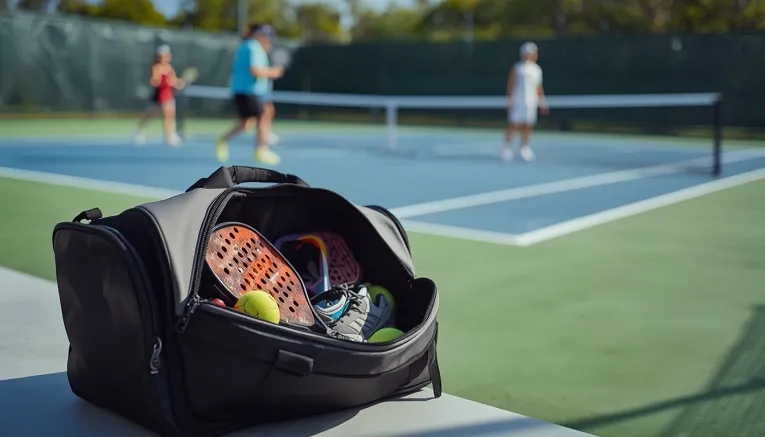
But the paddle is only the starting point. Serious players carry multiple paddles for different play styles. They need dedicated shoe compartments (court shoes get sweaty and heavy). They need ventilation for gear that accumulates moisture and need ball hoppers that hold 20 to 40 balls without deforming the bag’s structure. And they need all of this in a package that transitions smoothly from the car to the court to a post-game coffee run.
This is where the equipment design challenge becomes genuinely interesting, and where my two decades in bag manufacturing have given me a front-row seat to the transformation.
The Bag Problem: Why Generic Sports Bags Fall Short
Here is the central issue: most players started out stuffing their gear into whatever backpack or duffel they already owned. But as participation has grown, and as the player demographic has diversified, expectations for purpose-built pickleball gear have evolved dramatically.
The modern pickleball bag must solve several problems simultaneously:
Paddle protection. A $150 carbon fiber paddle cannot be tossed loosely into a backpack. Thermal-lined paddle compartments with structured walls are now standard on mid-range and premium bags, protecting equipment from warping in temperature extremes.
Ventilation and separation. Court shoes and clothing carry sweat and bacteria. Dedicated ventilated shoe compartments that isolate from clean gear are no longer a luxury; they are an expectation.
Organization at courtside. Players need quick-access pockets for phones, keys, and scorekeepers. Fence hooks keep bags off dirty ground on public courts. Ball compartments must be accessible without unpacking everything else.
Court-to-life versatility. This is perhaps the biggest design shift. Pickleball’s demographic skew, heavily concentrated among professionals aged 28 to 54, means players want gear that does not look like a neon gym bag. Clean silhouettes, minimal branding, and laptop sleeves are now part of the pickleball bag conversation. Some premium brands are pricing bags at $200 to $325, positioning them as lifestyle accessories rather than pure sports equipment.
At JUNYUAN BAGS, we have watched this evolution firsthand. Over 22 years of manufacturing bags for more than 200 brands across 100+ countries, we have seen category after category shift from “functional container” to “designed experience.” Pickleball is following the same trajectory that running, cycling, and travel went through before it, and it is happening at accelerated speed because the market grew so fast.
Material Innovation: Where the Real Competitive Edge Is Hidden
The visible part of pickleball equipment, paddles, shoes, apparel, gets the attention. But the real design competition is happening in materials, and this is where a manufacturer’s expertise determines whether a product succeeds or fails.
Consider the demands on a pickleball bag:
Abrasion resistance: Bags sit on concrete courts, get dragged across asphalt parking lots, and are stuffed into overhead airplane bins for tournament travel. Fabric choices like 600D polyester, ballistic nylon, or recycled RPET (recycled polyethylene terephthalate) determine whether a bag survives one season or five.
Water resistance: Outdoor pickleball is played in every condition. YKK AquaGuard zippers, welded seams, and water-resistant fabric treatments protect electronics and dry clothes inside.
Weight management: A bag loaded with 3 paddles, shoes, 30 balls, a water bottle, and a towel can easily exceed 15 pounds. Ergonomic strap systems, load-distributing back panels, and lightweight but strong materials are engineering challenges that require iterative prototyping and testing.
Sustainability: The fastest-growing segment of pickleball players, those aged 25 to 34, care about what their gear is made from. RPET fabrics, made from recycled plastic bottles, offer the same durability as virgin polyester while reducing environmental impact. Brands that integrate sustainable materials are not just checking an ethical box; they are responding to measurable consumer demand.
These are not marketing details. They are the engineering decisions that separate a bag a player uses for years from one that ends up in a landfill after one season. And they require deep manufacturing knowledge, the kind that comes from producing hundreds of thousands of bags across multiple sports categories, not from outsourcing to the lowest bidder.
What This Means for the Equipment Industry Going Forward
The pickleball equipment market was valued at approximately $485 million globally in 2025, with projections reaching $744 million by 2034. But those numbers capture only the direct market. The ripple effects extend far further: facility development, tournament infrastructure, coaching, apparel- all of it feeds into an ecosystem that rewards brands who understand equipment design at a fundamental level.
Three trends will define the next phase:
1. Specialization over generalization: The era of “one bag fits all” is ending. Tournament players need 6-paddle capacity with reinforced structure. Casual players want a slim sling that holds a paddle, two balls, and a phone. Women players, who represent a growing share of the market, are demanding bags designed around their carry needs, not simply repainted in different colors.
2. Cross-category expertise wins. The best pickleball bags borrow from tennis (paddle protection technology), travel (TSA-friendly organization), and everyday carry (laptop sleeves, clean aesthetics). Brands that can draw on multi-category manufacturing experience will outperform those trying to invent solutions from scratch.
3. Sustainability as a baseline, not a premium. As the player base continues to grow and younger demographics enter the sport, sustainable materials will shift from a selling point to an expectation. Manufacturers who invest in RPET supply chains and recycled-material processes now will have a structural advantage in the 2028 market and beyond.
The Bottom Line
Pickleball’s rise is not just a participation story. It is a design challenge, one that requires the same rigor, material science, and manufacturing depth that has always separated great sports equipment from mediocre equipment. The brands and manufacturers who treat pickleball gear design as a serious engineering discipline, not an afterthought, will be the ones that define this market for the next decade.
The ball is in play. The question is who is ready to swing.
About the Author:
Marvin Zhang is Co-Founder of JUNYUAN BAGS, a bag manufacturing company with 22+ years of experience producing bags for over 200 brands across 100+ countries. JUNYUAN BAGS specializes in sports equipment bags, travel gear, and sustainable bag solutions using RPET recycled materials. Learn more at junyuanbags.com.



More Stories